REVIEW · HO CHI MINH CITY
Ho Chi Minh City History And Culture Half-day Tour
Book on Viator →Operated by Hoi An Express Travel · Bookable on Viator
Saigon’s history hits fast here. I especially liked the combo of War Remnants Museum context plus hotel pickup that gets you moving without wasting time. One catch: the War Remnants Museum stop is only about 45 minutes, so you’ll want to skim strategically.
What really makes this tour feel “worth it” is that it stitches together multiple eras in one loop. You get French colonial showpieces like Saigon Notre-Dame Cathedral and the Central Post Office, then pivot to Chinese-influenced life in Cho Lon at Thien Hau Pagoda—with a short detour to see traditional lacquerware being made.
Timing is tight, and the group stays small (up to 15), so it’s a good match for first-timers, but not the best choice if you want to linger for long at a single museum. If you’re very tall, I’d also keep an eye on the vehicle fit; one reviewer mentioned a cramped ride with a low roof.
In This Review
- Key Highlights to Know Before You Go
- Entering The Saigon Loop: Why This Half-Day Works
- Pickup, Group Size, and Timing: How the Day Moves
- War Remnants Museum: Brief Time, Big Impact
- How to get the most out of 45 minutes
- Independence Palace: The Late-60s/early-70s Snapshot
- Saigon Notre-Dame Cathedral and the Central Post Office: French Design in Motion
- Notre-Dame Cathedral of Saigon (about 15 minutes)
- Saigon Central Post Office (about 10 minutes, admission free)
- Thien Hau Pagoda in Cho Lon: Chinese Temple Culture in 15 Minutes
- Lacquerware Factory Stop: A Small Glimpse of Craft
- Guides Make the Difference: Joseph, Hao, Bau, Lam, and One English Warning
- Price and Value: $36 for Museums, Entry Fees, and A/C Transport
- When This Tour Fits (and When It Doesn’t)
- Should You Book This Half-Day Saigon History Tour?
- FAQ
- How long is the Ho Chi Minh City History And Culture Half-day Tour?
- What does the tour price include?
- Which major stops are included?
- Are admission fees included?
- How large is the group?
- Is tipping included in the tour price?
Key Highlights to Know Before You Go
- A tight, focused 4-hour overview that hits the big names without dragging you across town for hours
- War Remnants Museum in 45 minutes with included admission, best for getting the story’s timeline rather than reading everything slowly
- Independence Palace for about 1 hour in the late-60s/early-70s era it preserves
- French colonial icons on short stops: Notre-Dame Cathedral and Saigon Central Post Office
- Cho Lon culture + craft: Thien Hau Pagoda and a lacquerware factory observation stop
- Guides matter: people specifically praised Joseph, Hao, Bau, and Lam, while one note flagged English difficulty
Entering The Saigon Loop: Why This Half-Day Works
This is the kind of Ho Chi Minh City history tour I recommend when you have limited time and want a “see it once, understand it better” route. In four hours, you cover the story beats that most first-time visitors struggle to connect: Chinese influence, French colonial rule, and the Vietnam War era—plus what daily life looks like in the city today.
I also like that the itinerary isn’t only museums and monuments. You touch religion and local craft with Thien Hau Pagoda and the lacquerware factory stop, so the city doesn’t feel like a chapter book you read and close. It feels more like a living place with layers.
The trade-off is the schedule. Short stops are part of the deal, and that’s especially true at the War Remnants Museum.
You can also read our reviews of more city tours in Ho Chi Minh City


Pickup, Group Size, and Timing: How the Day Moves
The tour runs about 4 hours, with hotel pickup and drop-off in Ho Chi Minh City center. Transportation is air-conditioned, and you get bottled water—small comforts that matter in Saigon’s heat.
The group size is capped at 15 travelers, which usually keeps things calmer than big coach tours. You also get an English-speaking guide (other languages are available with a surcharge), plus entrance fees for the ticketed sites, and travel insurance. Tickets are handled via mobile ticket, so you’re not stuck hunting for paper.
Plan your day around a smooth route, not a perfectly paced walk-through. This tour is built for moving between stops. If you’re the type who wants to linger in every room, you might end up wishing the day had one extra hour.
One more practical note from feedback: the transportation can be compact. If you’re sensitive about space or head clearance, take it into account when you’re getting in and out.
War Remnants Museum: Brief Time, Big Impact
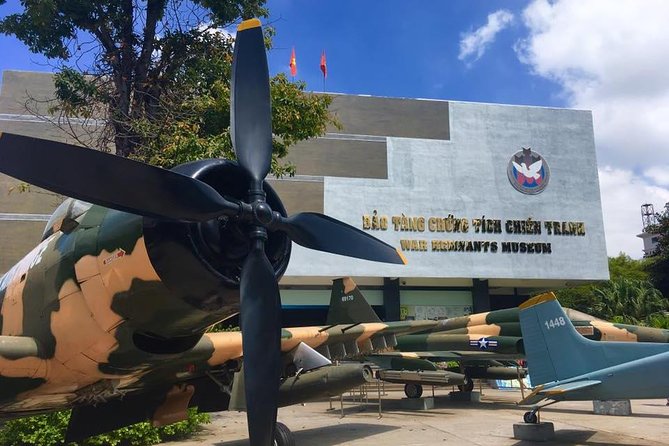
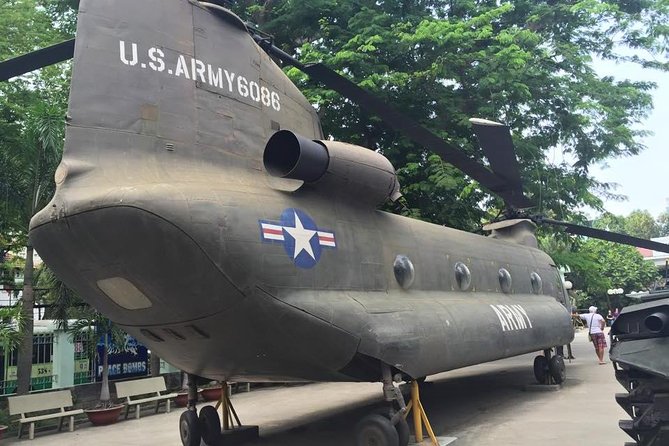
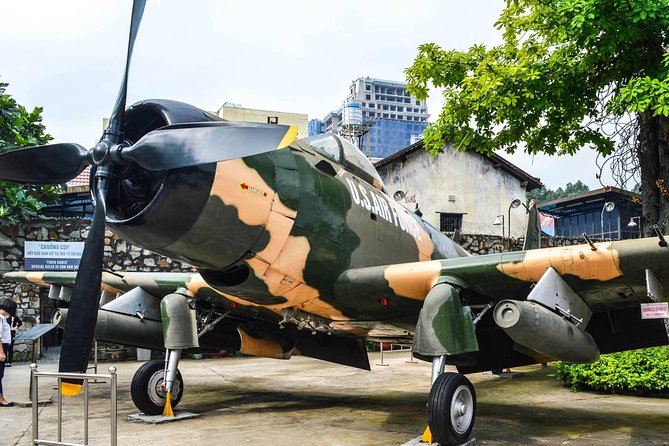
The War Remnants Museum is scheduled for about 45 minutes, and that’s the moment where you’ll either love the momentum or wish for more time. The museum is operated by the Ho Chi Minh City government, and an earlier version opened on September 4, 1975 as the Exhibition House for US and Puppet Crimes. Later, in 1995, it developed further after diplomatic normalization.
So what you’re getting in your time slot is a guided orientation to the museum’s themes, not a slow, room-by-room study. In a half-day format, this is smart: you leave with a clearer timeline and the key arguments the museum wants you to understand.
How to get the most out of 45 minutes
- Start with one or two themes you care about most (for example, the timeline versus the visual storytelling), and let the rest be context
- Don’t try to read every panel end-to-end; treat it like a guided map
- If war content hits you hard, give yourself breathing room after the museum so the rest of the tour feels manageable
I found the “right” approach is to think of the museum as the tour’s anchor. Then the later stops make more sense, because you’ll recognize what era you’re looking at.
Independence Palace: The Late-60s/early-70s Snapshot
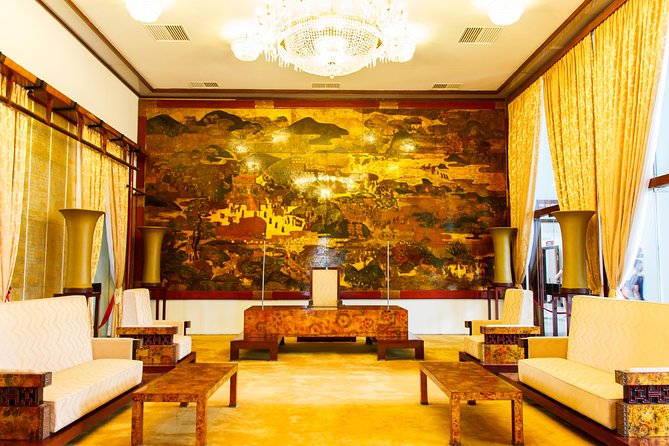
Next up is the Independence Palace (also known as the Reunification Convention Hall). This stop gets about 1 hour, and it’s one of the strongest pacing choices on the route. The palace is built on the site of the former Norodom Palace, and it’s a landmark in Ho Chi Minh City—formerly Saigon—so you’re not just seeing a pretty building. You’re seeing a place preserved as a historical snapshot.
Why this matters on a half-day tour: it gives you a physical sense of how power and events played out during the war years. It also helps you connect museum themes to real settings you can picture in your head.
If you’re coming to Vietnam for the first time, this is the kind of stop that can reframe everything else. People praised guides for making it feel practical and informative—one guide, Joseph, was specifically noted for flexibility and for sharing context about daily life, not just facts.
You can also read our reviews of more historical tours in Ho Chi Minh City






Saigon Notre-Dame Cathedral and the Central Post Office: French Design in Motion
After the palace, you move into the downtown area where French colonial architecture still shapes your walk.
Notre-Dame Cathedral of Saigon (about 15 minutes)
You’ll see Saigon Notre-Dame Cathedral Basilica in the downtown area. It was established by French colonists, originally named the Church of Saigon (with the French name starting as l’Eglise de Saïg… in the tour description). This stop is short—about 15 minutes—but it’s enough for the essentials: quick exterior viewing, a few photos, and orientation to why colonial design became part of Saigon’s identity.
Saigon Central Post Office (about 10 minutes, admission free)
Then it’s the Saigon Central Post Office, near the cathedral. Admission is free for this stop, and the tour allots about 10 minutes. The building was constructed while Vietnam was part of French Indochina, so it’s another “era marker.”
This combination works well because cathedral architecture and postal architecture tell two different stories. One is about religious authority and public presence. The other is about administration, communication, and how the French system tried to connect the colony.
Practical tip: dress with respect. For churches and pagodas, cover shoulders and avoid overly short clothing. You’ll feel more comfortable, and you won’t have to scramble at the last second.
Thien Hau Pagoda in Cho Lon: Chinese Temple Culture in 15 Minutes
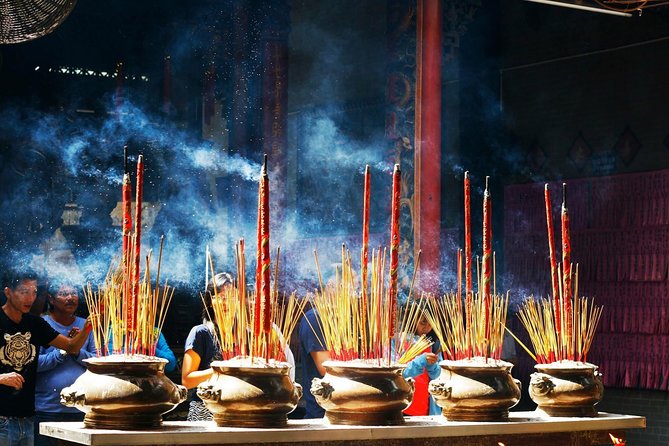
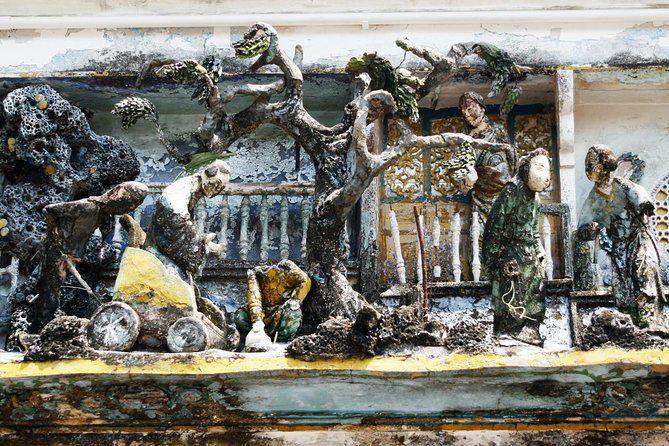
The tour shifts to Cho Lon (China Town) for Thien Hau Pagoda, also called Ba Thien Hau Temple in the tour description. The stop is about 15 minutes and it’s dedicated to Thien Hau, the Lady of the Sea—also known as Mazu (Tian Hou in Chinese).
This is where the tour adds cultural variety. You go from war-era context and French-era buildings into a religious space that reflects the city’s Chinese heritage. Even in a short time, you’ll usually get a sense of the rituals and the everyday importance of worship in a neighborhood setting.
Because the time is tight, your best move is to focus on observation rather than trying to “do everything.” Look around for how people behave, what offerings might be present, and how the space feels compared to the more European-feeling sites earlier.
Lacquerware Factory Stop: A Small Glimpse of Craft
The final scheduled stop is a Vietnamese lacquerware factory, with about 20 minutes on the clock. Admission for this part is listed as free. This is a more hands-on, sensory ending to a tour that started with heavy historical themes.
You’ll observe the process of making traditional lacquerware products. While the factory visit is brief, it’s still useful because it shifts your brain from political history to cultural production—how Vietnamese artisans build objects with layers of technique and patience.
I like this ending because it leaves you with something more memorable than just buildings. It also makes a great “second-day” prompt: after you learn the city’s layers, you can decide what type of souvenir or craft you actually want to bring home.
Guides Make the Difference: Joseph, Hao, Bau, Lam, and One English Warning
A standout theme in the feedback is that the guide can make the same tour feel either thin or satisfying. People highlighted specific guides by name: Joseph was praised for kindness and for rearranging the itinerary when needed, while Hao was described as awesome and attentive. Bau was noted for clear, fluent English. Lam received compliments for being accommodating.
That matters because your experience here is information-heavy. If your guide speaks clearly and can connect dates to what the city feels like, the short time works. If English is weak, the tour can feel like a checklist with less meaning.
So here’s the practical approach: if English is important to you, make sure you’re assigned an English-speaking guide. And don’t be shy about asking follow-up questions. When guides are good at explaining, that’s where the real value shows up.
Price and Value: $36 for Museums, Entry Fees, and A/C Transport
At $36 per person for about 4 hours, this is priced like an efficient “history sampler.” But the value isn’t just the low sticker price. The tour includes entrance fees, air-conditioned transportation, hotel pickup and drop-off in the city center, a travel insurance component, and bottled water.
In other words: you’re paying for logistics as much as for sightseeing. For a first-time visit, the biggest hidden cost is time. This tour is designed to use that time well, because you don’t need to arrange separate tickets, guides, or transfers between scattered sites.
If you want to do these stops on your own, you’ll likely spend more on transport and you may miss the connecting narrative. On the other hand, if you’re a museum deep-reader, the limited time at each stop might feel restrictive. In that case, the value calculation changes.
When This Tour Fits (and When It Doesn’t)
This is a great choice if:
- You want a fast overview of Ho Chi Minh City history and culture
- You’re visiting for the first time and want a coherent route from war-era sites to French colonial landmarks to Cho Lon culture
- Your schedule is tight and you’d rather pay for structure than plan a half-day on your own
It’s less ideal if:
- The War Remnants Museum is your top priority and you want more than 45 minutes there
- You’re tall or uncomfortable in smaller vehicles, since there’s at least one note about cramped transport with a low roof
- You prefer long, slow visits where you can sit and read without time pressure
Should You Book This Half-Day Saigon History Tour?
I’d book it if you want a clean introduction to the city’s most important landmarks without turning your day into a logistics project. The combination of the War Remnants Museum, Independence Palace, French-era icons, Thien Hau Pagoda, and the lacquerware factory gives you a balanced picture of what Saigon was, what happened here, and how culture continues.
I wouldn’t choose it as your only museum plan if you can’t stand time limits. If you care most about war history, consider adding extra time elsewhere—because this tour is built to cover the main beats quickly.
FAQ
How long is the Ho Chi Minh City History And Culture Half-day Tour?
It runs for about 4 hours.
What does the tour price include?
The price includes bottled drinking water, an English-speaking guide (other languages may be available with surcharge), hotel pickup and drop-off in Ho Chi Minh City center, travel insurance, entrance fees, and air-conditioned transportation.
Which major stops are included?
The tour includes the War Remnants Museum, Independence Palace (Reunification Convention Hall), Notre-Dame Cathedral of Saigon, Thien Hau Pagoda in Cho Lon, Saigon Central Post Office, and a Vietnamese lacquerware factory.
Are admission fees included?
Yes. Entrance fees are included for ticketed stops, and the Central Post Office and lacquerware factory stops are listed as free.
How large is the group?
The maximum group size is 15 travelers.
Is tipping included in the tour price?
No. Tipping for local guides is not included.